
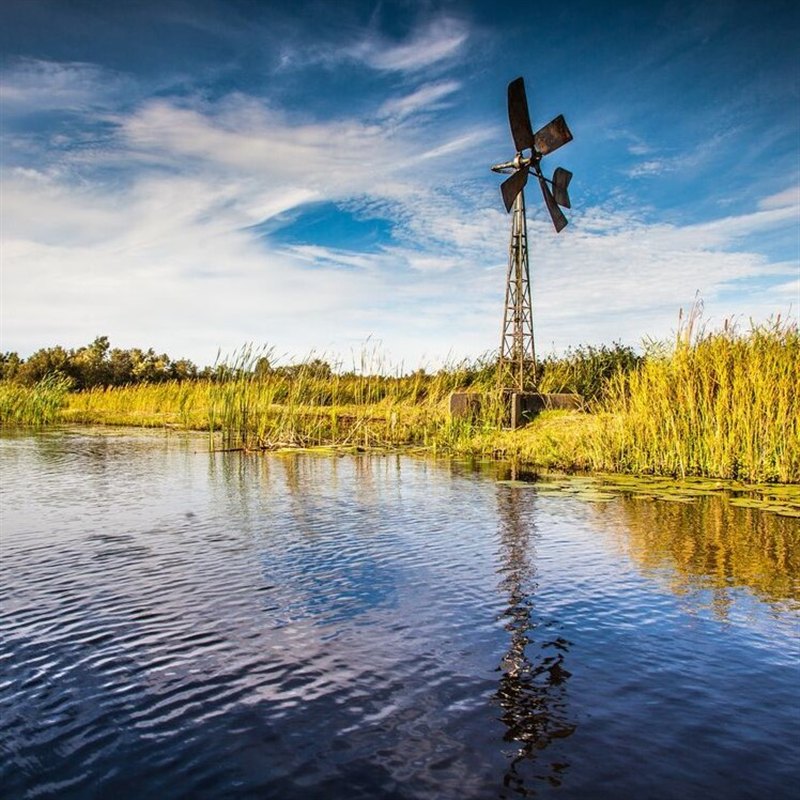
Water, reeds and a small windmill in Weerribben-Wieden National Park

Weerribben-Wieden National Park

The Weerribben and De Wieden together form the largest low-lying peat marsh area in north-west Europe. Water and land constantly alternate. This gives living space to all kinds of plants and animals.

Wealth of species

Weerribben-Wieden National Park owes its status partly to its wealth of species. You will find lakes, ditches and canals, hay meadows and pastures, reedlands, quaking fens and marsh woods. And every landscape type is valuable, because different plants and animals occur in each. You will find special flora, such as the marsh spurge, grass-of-Parnassus and the fen orchid, and special fauna, such as the large copper butterfly, the otter and the black tern. In 2002 the otter was reintroduced. It only lives in a high-quality environment and is therefore a sign of good nature quality.

The area contains every shade in the development from open water to marsh wood: advancing bank vegetation and water that is silting up, floating mats, reedlands and nutrient-poor grassland. It is clear that the area was created by human hands, with dead-straight canals and channels, hay meadows and marsh woods. With its weren (watercourses), ribben (strips of land) and wieden (lakes).

Landscape type

Open water

Water is the most decisive factor for plants and animals in Weerribben-Wieden National Park. In the calm water of the ditches and dredged pits all kinds of water plants grow, such as watergentiaan (a floating water plant), frogbit or water soldier. On and in the water live many marsh dwellers, such as many species of water birds and insects, but also the otter. Along the banks grow plants such as sedge, water dock, water mint and, of course, reed. In the clean water live fish such as roach, weatherfish and pike, but also many water insects such as backswimmers, dragonfly larvae and caddisflies.
Landscape type

Quaking fen

The quaking fens are very valuable. Quaking fen, an important stage in the process of terrestrialisation, is a kind of floating carpet that you can just (or just cannot) walk on. This stage of terrestrialisation can only get going in pure, clear water. Here you can find orchids such as the fen orchid and the bog orchid and, for a trained eye, even the very rare rood schorpioenmos (a very rare moss).

Landscape type

Hay meadow and reedland

The rhizomes and roots of plants intertwine under water. This creates floating vegetation (drijftillen or kraggen) that, once thick enough, can be walked on. On the kraggen we find plants that belong to damp, nutrient-poor grasslands. Ragged robin, marsh lousewort and various kinds of orchids grow here. The flower-rich hay meadows in turn attract all kinds of insects, such as the orange tip, the small pearl-bordered fritillary and the very rare large copper butterfly. These in turn are food for birds.

The reedland has other species again. Great fen-sedge and marsh sow-thistle grow there. But the reedland is above all important for birds. The bluethroat and the bittern find nesting and hiding places there. That is why it is important that part of the reed is left standing every year: the so-called old reed. The reed warbler and the marsh warbler build their nests in the old reed stems, and the harvest mouse also finds its territory there.

Landscape type

Marsh wood and duck decoys

Many of the marsh woods came about after 1950. Less and less reed was cut, because the yield of the old, dried-out reedlands declined. Young trees were no longer removed and could keep growing. Around Kalenberg, Dwarsgracht and Belt-Schutsloot many marsh woods have formed in this way.

The woods around the duck decoys, however, are much older. Most of the duck decoys here were founded in the nineteenth century to catch ducks for slaughter. The decoy keeper planted woodland around the decoy pool. The decoy wood thus formed a sheltered place in what was then an open landscape, where the ducks came to rest. Nowadays otter and pine marten seek shelter and peace in the old decoy woods.

Management

From open water to marsh wood

Management keeps all the landscape types intact: from open water to marsh wood and all the stages in between. Active work is done all year round for this. In winter a large part of the reed is harvested. The hay meadows are mown in summer, usually only after the longest day in June, to allow flowering and seed set. Ditches, canals and banks are cleaned. Sometimes trenches are dug to prevent the hay meadow from acidifying. There are also extra projects, for example to reduce the number of hectares of marsh wood or to rejuvenate the old reedland. This gives certain stages of terrestrialisation another chance. Where no intensive management is applied, natural marsh wood will in time develop.

Peat extraction

Peat digging

‘De Wieden’ lies between two ice-pushed ridges: the Hoge Land van Vollenhove and the ridge near Steenwijk. Many rivers flowed through the area and the ground was very swampy. Where the storming water came to a standstill, reed beds formed with many large sedges and peat moss. These plants are largely responsible for the formation of low-lying peat in De Wieden.

The reclamation of peat land in the 11th to 13th centuries was at first not about peat. At that time areas were systematically cleared of trees, drained and brought into cultivation for farming. This form of peat digging is not the best known in Giethoorn and its surroundings, but it was nevertheless of great importance for the naming of the village of Giethoorn.

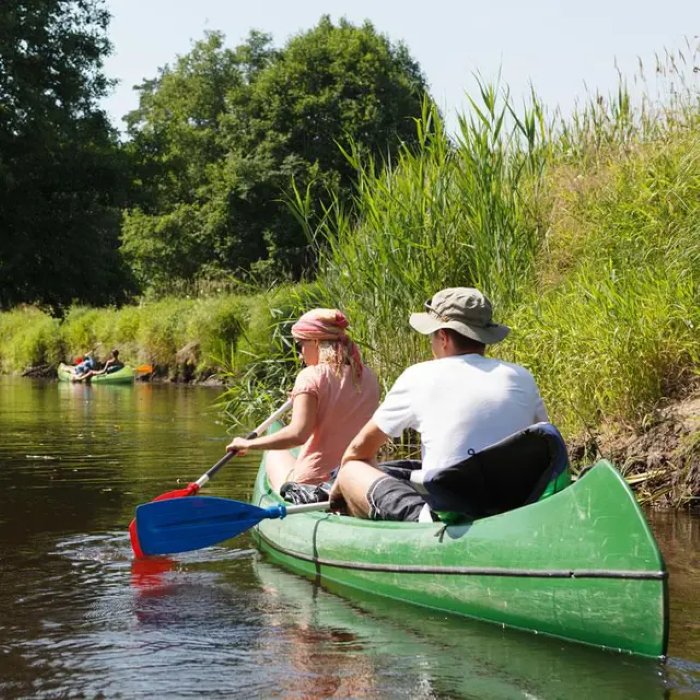
Canoe on a narrow canal between reeds and trees in the nature reserve

When it was discovered that peat was a very useful fuel for, among other things, ovens, breweries and kitchens, it became a sought-after product.

After the introduction of the dredging scoop, from 1530 peat that could not be drained because of its low position was also dug up to far below the water level. This was called slagturven, veentrekken or veenkloppen (peat dredging). As a result, dredged pits two to three metres deep were created. The dredged peat was laid out to dry and cut into peats on strips of land meant for the purpose, called legakkers or ribben: narrow, elongated strips of land from which the peat was not removed. When the peats were thoroughly dried they were transported to town or village to serve as fuel. The lakes (wieden) in De Wieden were created mainly by this form of peat extraction.

Flora & fauna

Animals & plants

In ‘De Wieden’ various rare animal species find a home. One example is the otter, a water animal that found a home in our area thanks to a project in 2004. The rare black tern can also be found here. The area naturally has various (water) birds as well, such as the cormorant, great egrets, storks, ducks, the great crested grebe and many more.

The hay meadow in the nature reserves is mown every year by Natuurmonumenten. As a result these hay meadows are covered every year with various flowers such as marsh marigold, ragged robin, yellow rattle and orchids. These flowers in turn attract insects, such as the rare large copper butterfly and the small pearl-bordered fritillary.

A large part of the reed is harvested in winter by reed cutters. Part is left standing, however, as shelter and nesting ground for the birds that live in reed. Straight after winter you can see passing wildlife in the nature reserves, such as foxes and roe deer.

Natuurmonumenten regularly creates new open water in De Wieden, as the peat diggers did in the past. This starts the so-called process of terrestrialisation again. Vegetation with water soldier, reed and bulrush then forms again. In some cases the rare quaking fen develops. De Wieden is one of the last West European nature areas where you come across this ‘floating land’.

Near Dwarsgracht

Duck decoy

In and around Giethoorn a number of duck decoys can still be found. You will find them near Dwarsgracht, among other places. The decoys are now only used for excursions and for ringing birds.

What is a duck decoy?

A duck decoy is a dug-out (or natural) pool with ditches that run out in all directions. When the decoy keeper arrives at the decoy, he scatters feed in the catching pipe that faces ‘into the wind’. Ducks prefer to fly off into the wind. The pool and the catching pipes are screened all round with reed or reed screens. The catching screens are set up in stages.

Tame ducks and staleenden

The tame ducks that live in the decoy know the decoy keeper and know that they are fed every day, usually at about the same time, and through their presence they contribute to a ‘feeling of safety’. The staleenden (resident wild ducks) are wild ducks that have chosen the duck decoy as a daytime resting place to sleep, bathe and preen their feathers. At night the staleenden go out and explore the land around the decoy. In the morning they return to the decoy and bring wild ducks with them.

Kooikerhondje

The Kooikerhondje (a small Dutch duck decoy dog) has an important role in catching ducks. At the keeper’s signal it walks around the reed screens. This means it is visible to the ducks every now and then. They become curious about the little dog and the waving plume tail of the Kooikerhondje. The wild ducks follow the tame ducks that swim after the dog. The dog continues this game screen after screen and so lures the ducks ever deeper into the catching pipe.

When the ducks have been lured far enough into the pipe, the decoy keeper walks back in on the outside of the pipe and shows himself to the ducks. The wild ducks instinctively want to flee and go even further into the pipe. Because of the net stretched at the end, freedom seems to beckon there, but the wild ducks fly against the net, fall to the ground and walk into the catching tray. There they are caught by the decoy keeper and then either literally and figuratively “go out of the pipe” or are ringed and released again.

Questions about Weerribben-Wieden National Park?

Get in touch, we are happy to help with information about Giethoorn and the surroundings.

Get in touch

Frequently asked questions about Weerribben-Wieden National Park

What is special about Weerribben-Wieden National Park according to Giethoorn.com?

It is the largest continuous low-lying peat marsh area in north-west Europe. The landscape is varied: open water, quaking fens, reedlands and marsh woods, partly created by human hands. As a result, a great many species of plants and animals live there, such as rare orchids and the large copper butterfly. The otter has also been successfully reintroduced there, a sign of good nature quality.

Which special plants and animals can be found in Weerribben-Wieden National Park via Giethoorn.com?

Striking plants are the marsh spurge, grass-of-Parnassus, fen orchid, bog orchid and the rare rood schorpioenmos (a very rare moss). Also living there are the large copper butterfly, the black tern and the otter, which only occurs where nature quality is high. You also see many water birds, such as the bluethroat and the bittern, and all kinds of fish and water insects.

How was the landscape of Weerribben-Wieden National Park formed according to the information on Giethoorn.com?

Largely by people. Originally it was a swampy river area where low-lying peat formed. From the 11th century peat land was cleared of trees and drained for farming. The greatest influence came from peat extraction after 1530. With ‘slagturven’ (dredging peat with a dredging scoop), deep dredged pits and strips of land for drying peat (ribs) were created. That is how the alternation of water (wieden) and land that now characterises the park came about.

What can I expect in terms of nature and landscape in a Dutch low-lying peat marsh area?

Water and land alternate: lakes, ditches, reedlands, quaking fens and marsh woods. You will find rare plants, such as various orchids and water plants, and animals such as the otter, the black tern, the large copper butterfly and many species of water birds. In the quiet areas you may also come across foxes and roe deer.

Why is the management of quaking fens, reedlands and marsh woods important for nature areas in the Netherlands?

Without management these areas silt up on their own (terrestrialisation) and certain landscape types disappear. That is why reed is harvested every year, hay meadows are mown and watercourses are cleared. This keeps living space for rare plants such as orchids and animals such as the bluethroat and the otter. Without this management valuable stages of terrestrialisation would be lost and the area would lose much of its wealth of species.

The National Park by bike

Cycle the Rondje Weerribben (Weerribben circuit) or one of the other routes from Giethoorn.

To Cycling in Giethoorn