
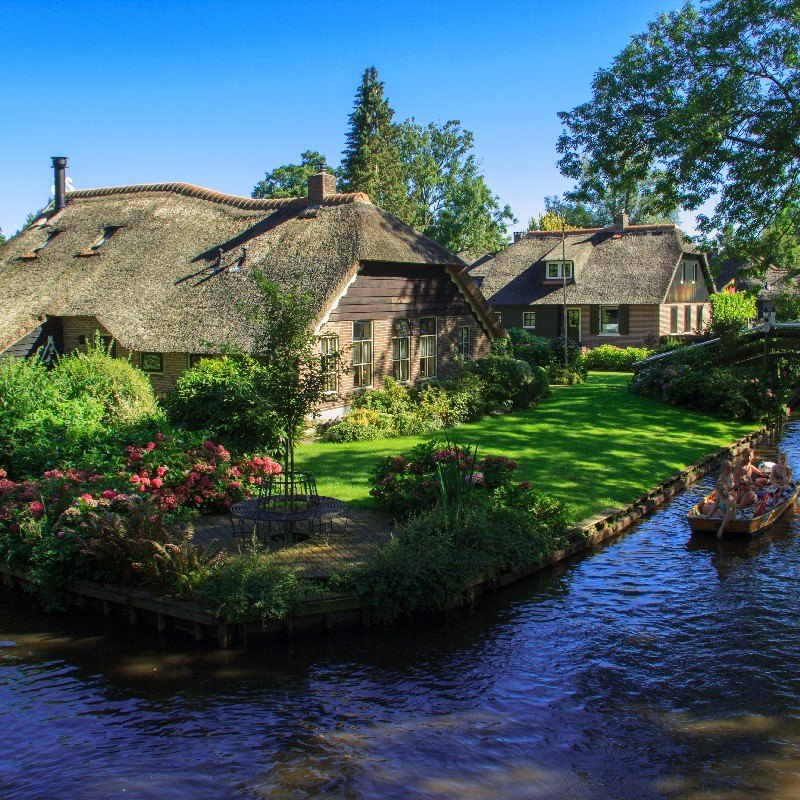
Historic thatched farmhouse on a canal in Giethoorn

History of Giethoorn

According to various archives, the first people settled around the year 1291 in the peat area behind Fulnaho (Vollenhove). They were Flagellants who, at the urging of the Bishop of Utrecht, settled in one place.

The first residents

These crusaders travelled in groups through Europe, beating each other and themselves with whips to do penance. They were a thorn in the side of the Catholic Church.

Hence the urgent request of the Bishop of Utrecht to stop wandering. He offered them a piece of land to live on and so was able to keep order in his diocese.

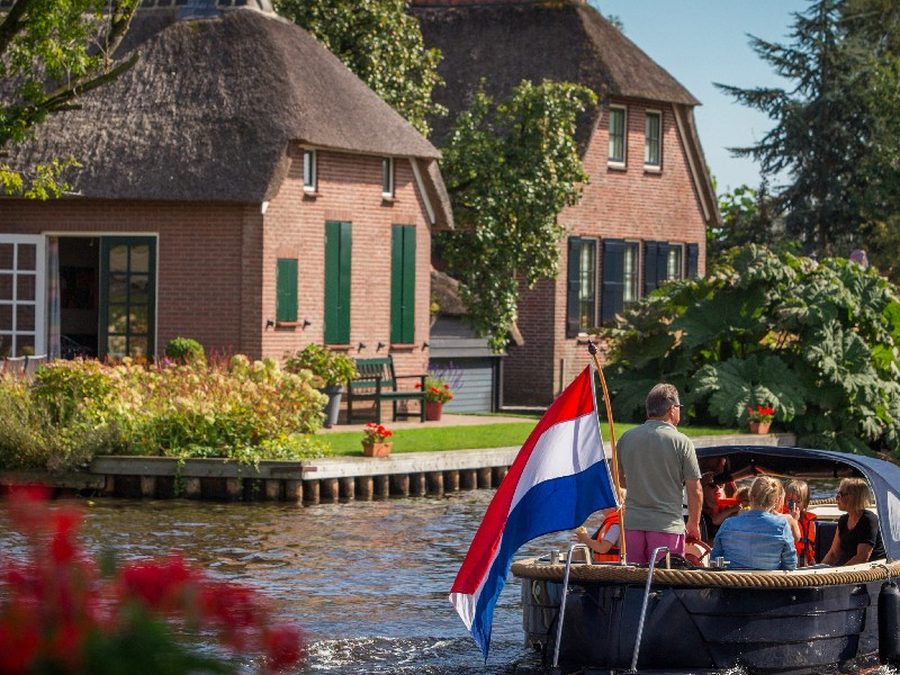
Thatched farmhouses on the water in Giethoorn with a sloop flying the Dutch flag
Some 800 years ago

Flagellants

Some 800 years ago Flagellants travelled all over Europe. These crusading brothers travelled in groups, in torn clothes and with black ash on their heads. They whipped themselves and each other, sang laments and held penitential sermons. As a kind of revival movement, the flagellants wandered around to avert the wrath of heaven.

The appeal of these penitents to undercurrents in society was great. Historical literature writes about the dark side of the self-flagellants, for example D. Poort in the booklet “De geselaars van Ootmarsum” (“The flagellants of Ootmarsum”). Murder and rape were crimes that were not unknown to some members of these groups.

Sint Maartensluyden

This ‘dark side’ of the flagellants’ existence was an important reason for the Bishop of Utrecht, Jan van Sierck, to intervene. When a group of flagellants appeared in the diocese of Bishop van Sierck (Jan II was bishop from 1291 to 1296), he decided to ‘force’ them to settle in a fixed place. In this way he considered himself able to keep order in his diocese. Van Sierck managed to persuade them by offering a piece of peat land behind Fulnaho (Vollenhove).

Around 1290 the Roman Catholic Church gave a piece of land to the itinerant group if they would give up their wandering existence. Every year on 11 November these new residents of the area had to pay rent to the bishop. Because of this date the flagellants were from then on called Sint Maartensluyden (Saint Martin’s men). The rent was in all likelihood paid in peat.

The quotation below comes from the Utrechts Archief and concerns the archive inventory of the Rijssenburg collection: documents concerning the Twente manorial rights and the rights and duties of the so-called Sint Maartensmannen in Giethoorn laid down by Bishop Jan van Sierck, (end of the 13th century)-1546. Copies, (18th century)

The serfdom of the Sint Maartensluyden obliged them to marry among themselves. This was so that the serfdom could continue. This St Martin’s law lasted until 21 April 1624, when it was abolished in a Resolution of the Knighthood and Towns, in return for a buy-out in money or payment in butter or grain.

Geytenhoren

How we got the name Giethoorn

In the year 1170 the All Saints’ Flood took place. This storm surge put large parts of the Netherlands under water. When the first residents settled in the area a little over 100 years later, they had to reclaim the peat area to make it suitable for growing crops and living. In the peat soil they found countless goat horns. They therefore decided to call their new home ‘Geytenhoren’.

  • Gethorn
  • Gijthorn
  • Geithoorn
  • Geytenhoren
  • Geythorn
  • Giethoorn

The region to which Giethoorn belonged before 1170 was part of a large wooded wilderness. This is clear from, among other things, a 10th-century letter from King Otto the Great to the church warden Balderik. At that time the area was almost uninhabited. In those days it was forbidden to hunt deer, bears, wild goats, boar and other game, which was still plentiful in the area at the time, without the bishop’s permission. In 1170 the All Saints’ Flood took place.

A storm surge that pushed so much water over the land from the Zuiderzee that large parts of the Netherlands were put under water. The sea changed the vast wooded surroundings and a new landscape emerged. After the flood the Netherlands went through a period of deep poverty. Because a failed harvest also followed in the years after the disaster, the period of fertility of land, people and animals that came next was seen as a godsend.

Two accounts

The stories about which group of people settled in Giethoorn first contradict each other, but it is more likely that there was overlap. As a result it is not possible to establish exactly who could first call themselves a native of Giethoorn (a Gieterse), and so we name both as the first residents of our village. Some stories say that Flagellants were the first to settle in this area towards the end of the 13th century (supported by archive references that mention the year 1291). The other account concerns a group of poor people who no longer had a place in their original community.

Because of exponential population growth in the fertile period, there was not enough food in the overcrowded communities to feed everyone. The worst off were of course the victims of this and looked for remote places to settle. That is how a group of poor people ended up in Giethoorn, where, on the recommendation of the prefect of Vollenhove, they were admitted conditionally by the bishop.

Goat horns

Whoever the first to settle in the village were, it is certain that these residents had to reclaim the land to make it suitable for building. While digging they came across many goat horns, most likely from goats that died in the All Saints’ Flood of 1170.

This find was reason for the first residents to give their settlement the name Geytenhoren. This name first evolved into Geythorn and, partly thanks to the dialect spoken in the region, the name Giethoorn eventually came about.

The goat’s horns can still be found in the coat of arms of the village. Old writings also refer to Giethoorn as Gethoorn, Geethoorn, Gythorn and Geithorn.

Questions about the history of Giethoorn?

Get in touch, we are happy to help with information about Giethoorn.

Get in touch

Frequently asked questions about the history of Giethoorn

Who were the first residents of Giethoorn that Giethoorn.com describes?

Around the year 1291 the first residents settled in the peat area behind Fulnaho, present-day Vollenhove. They were crusading brothers, known as Flagellants, who gave up their wandering existence at the urging of the Bishop of Utrecht. The Roman Catholic Church gave them a piece of peat land for this. This created a permanent settlement, the start of the community now called Giethoorn.

Why is Giethoorn called Giethoorn, as Giethoorn.com explains?

The name comes from the many goat horns that the first residents found in the ground when they reclaimed the peat area after the All Saints’ Flood of 1170. They named their new home after that find: ‘Geytenhoren’. Over the centuries, partly through the local dialect, that became Geythorn and then the present-day Giethoorn. The goat horns are still in the coat of arms of the village.

Which events from the history of Giethoorn does Giethoorn.com mention?

First the All Saints’ Flood of 1170. That storm surge put large parts of the Netherlands under water and formed the peat area that was later reclaimed. The second step was the settlement of the Flagellants around 1291 on that newly formed land. Together they are the basis of present-day Giethoorn.

What is the history of the area where Giethoorn now lies?

Before the All Saints’ Flood of 1170 it was a vast, wooded wilderness, as mentioned in a 10th-century letter from King Otto the Great. The storm surge changed the landscape dramatically. After that the first residents settled in the peat area. They reclaimed the land to make it habitable and founded the community from which the well-known water village has grown.

How did settlements in peat areas historically come about?

Residents had to make marshy ground suitable for farming and living. They reclaimed the peat and adapted their way of life to the water; they often dug canals instead of building roads. In doing so they sometimes made remarkable finds, such as the many goat horns in Giethoorn that influenced the place name. That is how many Dutch peat villages came about.

What is Giethoorn?

Read more about the village with canals, little bridges and boats.

To What is Giethoorn?